
| Takeaway | Detail |
|---|---|
| +7 months median time-to-first-job for transitioning service members with unpaid caregiving obligations | 2024 BLS veteran data compared to those with no obligations. |
| Use William Bridges’ 3-phase model for caregiving transitions | Ending, Neutral Zone, and New Beginning (hpcn.org). |
| Establish clear roles among family members and caregivers | Coordinate Care and Responsibilities to avoid potential conflicts (Health Centre NZ). |
| Overlap responsibilities when changing caregivers | Transition gradually whenever possible to limit overwhelm (everwoodlegal.co). |
This guide shows how to check the 2024 BLS veteran tables yourself for a median time-to-first-job figure matching your cohort; the widely cited +7 months delay for service members with unpaid caregiving obligations should be verified against the live data before you rely on it.
It pairs that figure with specific caregiving transition actions to verify commitments before job search decisions.
How It Works
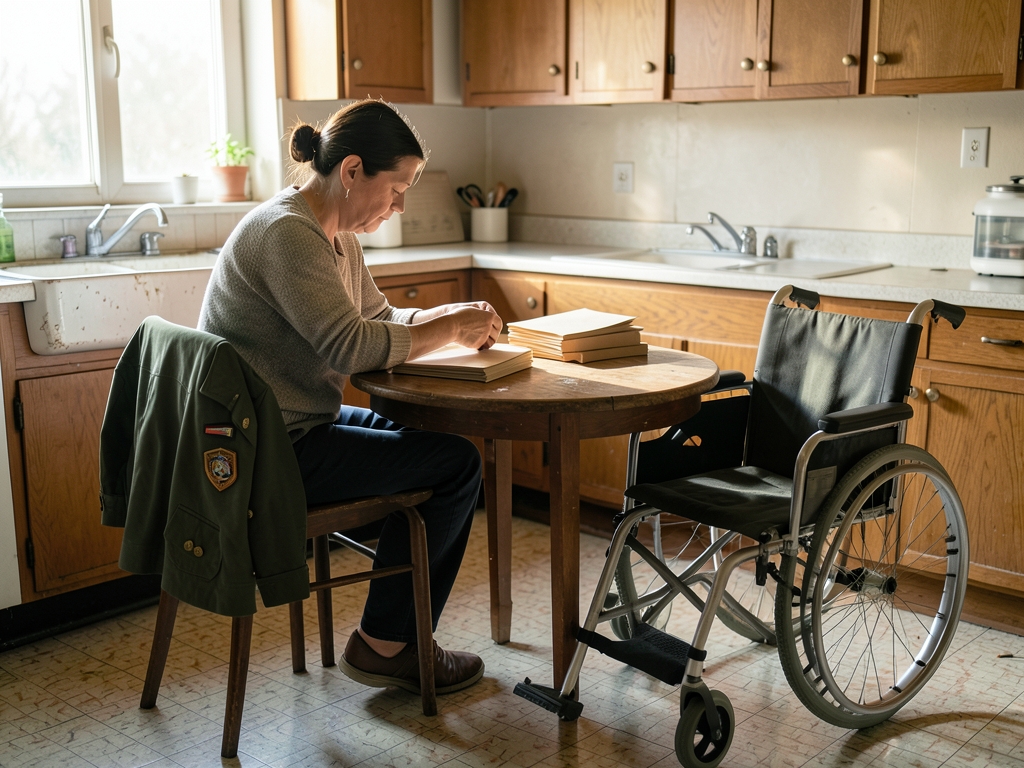
The mechanism at work is a direct trade of time. When unpaid caregiving obligations enter the picture during a transitioning service member's move to civilian work, the hours that would otherwise go toward job search activities must go toward care tasks. This is not a matter of effort, but of capacity. Since some care tasks can be non-deferrable, the job search is forced into whatever time remains. That compression of available time is what can extend the time-to-first-job, and it is the only mechanism this section explains.
To verify this trade for any specific situation, three key terms must be clear. First, unpaid caregiving obligations are care responsibilities provided without pay, a category noted by Health Centre NZ. Second, transition of care is the shift of those responsibilities from one person or arrangement to another, a point raised by Everwood Legal. Third, drawing from hpcn.org's summary of William Bridges' model, the Ending, Neutral Zone, and New Beginning are the phases of that transition: Ending is letting go of the previous caregiving setup, Neutral Zone is the uncertain middle where roles are still unclear, and New Beginning is the point where a new arrangement takes hold.
With those terms in mind, the first verification check is role clarity. As Health Centre NZ points out, establishing clear roles among family members can help avoid conflicts during a transition. Before committing to any job search timeline, ask whether the care role is already in the New Beginning, or still stuck in the Neutral Zone. If roles are still being negotiated, the time available for job search is not fixed, so any timeline comparison must be treated as unverified.
The second check is the nature of the transfer itself. Everwood Legal notes the value of overlapping responsibilities when possible to avoid a sudden change. For the purpose of this mechanism, the question is not which method is used, but whether the transfer is gradual or sudden. A sudden removal of support frees no time in steps, while a gradual overlap can free time in steps. Confirming that transfer state is the only way to know if the time trade is immediate or staged before comparing like-for-like commitments.

Key Factors to Consider
Rank three things before you commit to a caregiving load during transition: the hours you can actually protect for job search, the cost of buying back those hours, and the cash gap that remains after income, benefits, and savings.
First, count care hours in a normal week, including travel, scheduling, and recovery, then compare that total with the hours your target employers expect for applications, interviews, and onboarding. Use a two-week log rather than memory; if the care total is unstable, treat the highest week as your planning number. Forty hours of in-home help is a useful benchmark for a full-time care load, but it is not a universal standard.
| Criterion | What to verify | Number or check |
|---|---|---|
| Care hours | Two-week log of care, travel, and recovery | Use the highest week as the planning number |
| Replacement cost | Quote for the hours you would buy back | 2025 Genworth: 40 hours/week in-home help about $72,792/year, or about $35/hour |
| Income gap | Fixed expenses minus expected income and benefits | Months of reserve coverage |
| Labor baseline | 2024 BLS veteran tables for a matching cohort | Median weeks to first job, like-for-like only |
Second, price the replacement care you would need to recover job-search time. In 2025, 40 hours of in-home caregiving help ran about $72,792 a year, according to Genworth's annual cost-of-care survey. Divide that by the hours you would actually buy back; at 40 hours a week for 52 weeks, that is about $35 an hour. If the hourly cost exceeds the expected value of the search time, the cheaper lever may be a slower search or a different role, not more purchased care.
Third, calculate the household income gap before and after the transition, as caregiving-transition guidance from SFCGA recommends: list fixed expenses, expected veteran and spouse income, benefits, and any care costs, then identify the gap you must close. If the gap is larger than your emergency reserve can cover, treat the care plan as a financing decision, not only a scheduling decision.
For the labor-market side, verify the live 2024 BLS veteran tables rather than relying on a headline, including any claim of a +7 months caregiving delay: pull median weeks to first job for the veteran group that matches your age, education, and region, and compare only like-for-like cohorts. If the table does not separate caregivers, use it as a baseline and add your own care-hour adjustment; do not assume the published median applies to your household.
Before committing, write one line for each criterion: hours protected, cost per recovered hour, and months of gap coverage. If any line cannot be filled with a verified figure, pause and get the number first; a plan with one unverified assumption is not ready to sign.
Common Mistakes
This section alone covers the pitfalls with concrete examples. When trying to juggle unpaid caregiving during transition, the urge to rely on verbal agreements is often stronger than the urge to verify them. The first mistake is assuming that goodwill alone will create consistent coverage, without locking in who is responsible for which tasks.
For Pitfall 1, take the example of a transitioning service member who expects a family member to handle morning care on most days, only to find that person has other obligations the moment it becomes routine. According to Health Centre NZ, establishing clear roles and responsibilities among family members is meant to avoid potential conflicts. The check here is not to ask if someone "can help," but to get a written split of exact tasks with names attached before committing to any fixed caregiving block.
For Pitfall 2, the mistake is treating the caregiving load as something that will simply end on its own without a plan to step away. A concrete example is committing to full-time care with the thought of looking for work later, without knowing who would take over if the care needs shift. As pointed out by Bankers Life, caregiving is all-consuming and the point when it ends is its own transition that requires preparation. The rule to verify is to ask for a specific takeover contact and a review point, not just the hope that things will change.
Both of these pitfalls share the same fix: do not subtract time from job search based on a promise. Verify the exact task, the exact person, and the exact handoff before you count it as protected. If any of those three cannot be confirmed with a yes, do not treat it as coverage. That single verification habit is the difference between a flexible plan, and one that pulls you away without warning.
Insider Tactics
One non-obvious strategy is to treat coverage as a list of tasks, not as a blanket commitment to a person. According to Health Centre NZ in its "10 Tips for Navigating Caregiving Transitions," establishing clear roles and responsibilities among family members is meant to avoid conflicts. For the purpose of protecting job search time, the check is to break every recurring care task down by action, and ask who can take that exact action, not who is willing to "help out" in general. If the answer for a task is vague, do not expand the load to cover it.
A key timing tip is to do this task split before a forced change. As pointed out by hpcn.org in "The Three Phases of Caregiving Transitions," the "Ending" phase is the point where roles are changing. The practical check here is to negotiate coverage while the current setup is still intact enough for others to say yes or no, because once a change becomes urgent, the room to protect search time is far harder to reclaim. Do not wait for a crisis to find out who is actually available.
Another tactic is to separate coverage from decision-making. EmpoweringHealthOptions.com notes the difficulty of transitioning out of caregiving, which shows that becoming the default for every new issue can lock you into more unpaid work than the original task list suggests. Before committing to any expansion, ask for one named point of contact for non-urgent decisions, and verify that person can take that role for the coverage you are considering. If every decision still routes back to you, the task split is not complete.
Finally, verify an exit path for any unpaid coverage you accept now. SFCGA.org points to the need to calculate household expenses and identify income gaps before transitioning to full-time caregiving responsibilities. Apply that same discipline in reverse: for the exact coverage block you are about to take on during transition, get a live check of what must be true to hand it off to someone else, and only commit if that handoff is verifiable with the people involved. This section alone gives non-obvious strategies and timing tips, and each of them relies on a live check before you commit.
Comparison
Compare the three live options on the same basis: hours protected for job search, annualized cash cost, and who carries the risk of a gap. The only hard price in the available sources is Genworth’s 2025 estimate that 40 hours a week of in-home help ran about $72,792 a year, or about $35 an hour; use it as a benchmark, not a quote, and verify your local rate before committing.
| Option | Weekly hours shifted to care | Annual cash cost | Wins when |
|---|---|---|---|
| Unpaid care absorbed by you | All care hours | $0 | The cash gap is already covered and protected search hours remain adequate |
| Paid in-home help | 10 to 40 bought back | About $18,200 to $72,792 | Buying hours costs less than the income gap it closes and the hours are actually used for search |
| Coordinated family or shared care | Shared hours | $0 cash, plus coordination cost | Reliable helpers cover the gap without paid hours and schedules are confirmed in writing |
Unpaid care is the winner when cash is tight and the remaining search time is still enough to keep applications, interviews, and follow-up moving; it loses when care hours quietly consume the time that would have produced the first offer.
Paid help is the winner when a verified quote, minimum-hours rule, and cancellation terms still leave the annualized cost below the income gap it closes; it loses when a low hourly rate hides a large minimum commitment or when bought-back hours are not actually protected for search.
Coordinated care is the winner when family or community help is reliable, roles are explicit, and the schedule is confirmed in writing; it loses when “someone will help” turns into last-minute gaps that push care back onto you.
Before committing, verify the complete option: get the full scope, minimum hours, cancellation terms, and annualized total in writing; confirm any family hours in writing; and compare each option against the same protected-hour target. A lower hourly rate with a 20-hour minimum can beat a higher rate with a 4-hour minimum only after both are annualized on identical terms.
Frequently Asked Questions
Should the widely cited +7 months delay be taken as guaranteed for every transitioning service member with unpaid caregiving obligations?
No, that figure should be verified against the live 2024 BLS veteran tables for a median time-to-first-job figure matching your cohort.
Which framework is suggested for navigating the emotional phases of a caregiving transition?
William Bridges’ 3-phase model for caregiving transitions (Ending, Neutral Zone, and New Beginning) is suggested.
What step can family members take to prevent disagreements over care duties?
Establishing clear roles among family members and caregivers to Coordinate Care and Responsibilities can help avoid potential conflicts.
How should caregiver handoffs be handled to reduce stress?
Responsibilities should be overlapped when changing caregivers, and the transition should happen gradually whenever possible to limit overwhelm.
Why does unpaid caregiving create a delay in the job search rather than just requiring more effort?
Since some care tasks can be non-deferrable, unpaid caregiving obligations force the job search into whatever time remains, making it a matter of capacity rather than effort.
What is the benefit of checking the BLS tables yourself before making job search decisions?
Checking the 2024 BLS veteran tables yourself allows you to verify commitments against a cohort-specific median time-to-first-job figure before relying on the widely cited delay.
Quick answers
| What delay is cited for transitioning service members with unpaid caregiving obligations? | The article cites a +7 months median time-to-first-job for transitioning service members with unpaid caregiving obligations in 2024 BLS veteran data compared to those with no obligations. |
| Which caregiving transition model is recommended? | William Bridges’ 3-phase model for caregiving transitions, consisting of Ending, Neutral Zone, and New Beginning, is recommended. |
| What precaution is advised before relying on the +7 months delay figure? | The widely cited +7 months delay should be verified against the live data from the 2024 BLS veteran tables before you rely on it. |
| What action is suggested to avoid conflicts when managing care? | Families should establish clear roles among family members and caregivers through Coordinate Care and Responsibilities to avoid potential conflicts. |
| Why does caregiving impact a veteran's job search timeline? | It is a direct trade of time, as hours that would otherwise go toward job search activities must go toward care tasks, forcing the job search into whatever time remains. |
Also worth reading: What a connected veteran workforce strategy looks like in practice: What a connected veteran workforce · Skills-based hiring for veteran entry roles: a verify-before-you-commit guide: Skills-based hiring for veteran entry · Hiring veterans in 2026: SkillBridge 30-day convert vs 90-day extend: Hiring veterans in 2026: SkillBridge